
pain and suffering

Matthew 27:46
"And about the ninth hour Jesus cried with a loud voice, saying, Eli, Eli, lama sabachthani? that is to say, My God, My God, why hast Thou forsaken Me?"

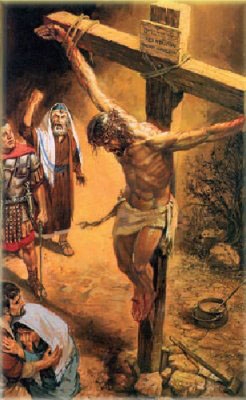
We should keep studying the questions that Jesus asked. Jesus's questions are very educational. This week, "My God, My God, why hast Thou forsaken Me?" When Jesus hung on the cross He was in agony and literally dying. The pain He was experiencing was in the EXTREME. His loss and separation was on full display for ALL to see. Anguish doesn't begin to describe His experience on the cross.

Jesus’ cry happened around 3 pm as He was experiencing the full weight of humanity’s sin and God’s wrath. Jesus felt abandoned by God. A feeling He would never have known before. Yet, it had some familiarity as He had the experience of being GOD rejected and abandoned by people. It's here on the cross where people and GOD are reunited!

This question and this feeling is known to all of us. We might see it as part of the human condition. But, we may also appreciate that GOD has this experience too. It should not surprise us to find a record of this feeling in the Old Testament. Turn to the Psalms, chapter 22, verse 1, "My God, my God, why hast Thou forsaken me? why art Thou so far from helping me, and from the words of my roaring?" This verse has various interpretations over time. We can say for sure that it is a lamentation of the righteous suffering of the psalmist. In these words, we can see a powerful expression of Jesus’ humanity AND divinity, as He experienced the suffering of humanity and the wrath of God. It serves as a testament to the depth of His love and sacrifice, as He cries out in anguish, feeling abandoned by God, yet ultimately fulfilling the plan of redemption. It's on the cross where He saves us. And, it's where we meet Him properly, sharing a small taste of His pain and suffering.
Comments

Popular posts from this blog

Elisha’s example

1 Kings 19:19-21 "19 So he departed thence, and found Elisha the son of Shaphat, who was plowing with twelve yoke of oxen before him, and he with the twelfth: and Elijah passed by him, and cast his mantle upon him. 20 And he left the oxen, and ran after Elijah, and said, Let me, I pray thee, kiss my father and my mother, and then I will follow thee. And he said unto him, Go back again: for what have I done to thee? 21 And he returned back from him, and took a yoke of oxen, and slew them, and boiled their flesh with the instruments of the oxen, and gave unto the people, and they did eat. Then he arose, and went after Elijah, and ministered unto him." In Luke 9:54, after James and John sought to call down fire on a Samaritan village that rejected Jesus, they referenced Elijah, saying, “even as Elias did?” Jesus then taught three lessons about rejection: 1- Discipleship demands sacrifice, embracing hardship and forgoing earthly security. 2- Following Jesus requires immediate, un...

I will make you

Matthew 4:19&20 "19 And He saith unto them, Follow Me, and I will make you fishers of men. 20 And they straightway left their nets, and followed Him." In our "Follow Me" series, we study Jesus calling His disciples in the Gospel of Matthew. By the Sea of Galilee, a thriving fishing hub, Jesus saw Simon and Andrew casting nets as humble fishermen. His disciples were ordinary workers, not wealthy or educated elites. Jesus approached them and said, "Follow Me, and I will make you fishers of men." Remarkably, they immediately left their jobs to follow Him. This brief exchange conveys a profound truth: Jesus says, "I will make you." Only God can transform us to accomplish His purpose. We should often pray, "Help me, God," seeking Jesus' guidance to follow His plan for our lives.

God’s patience

2 Peter 3:9 "The Lord is not slack concerning His promise, as some men count slackness; but is longsuffering to us-ward, not willing that any should perish, but that all should come to repentance." God did not immediately punish King Solomon when he allowed his foreign wives to build altars for false gods. Despite multiple compromises, God remained patient. Over time, Solomon’s endorsement of idolatry defied God’s covenant, leading to divine judgment, including the loss of the kingdom for his son. Some mistake God’s patience for indifference or inaction, but He follows His plan in His timing. If our nation, culture, church, or we ourselves stray like Solomon, we can repent and return to God’s path. And, should do so sooner than later! Amen!