
virtuous woman

Ruth 3:11&12
"11 And now, my daughter, fear not; I will do to thee all that thou requirest: for all the city of my people doth know that thou art a virtuous woman.
12 And now it is true that I am thy near kinsman: howbeit there is a kinsman nearer than I."

Naomi and family experienced tragedy in Moab. Afterwards Naomi returned to her hometown, Bethlehem, with one of her daughters in law; Ruth. Ruth, the Moabite, who just lost her husband, left everything behind! Ruth is STEDFAST and FAITHFUL.

Naomi and Ruth had lost everything. They were among the poorest of the poor. Ruth caught the attention of Boaz, a relative of Naomi's. Boaz admired the quality of her character and credited her with great trust in GOD! She must have stood out amongst the Israelites who were doing what was right in their own eyes. 

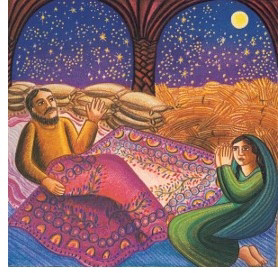
On one occasion Ruth is interacting with Boaz. She spreads part of his skirt over herself and asked for more covering. This action in this culture would indicate that she belongs to Boaz. Symbolic not only of protection also synonymous with showing that he married her. Boaz is very tender and careful with his response to Ruth in today's verses; "And now, my daughter, fear not; I WILL DO to thee all that thou requirest: for all the city of my people doth know that thou art a VIRTUOUS WOMAN. And now it is true that I am thy near kinsman: howbeit there is a KINSMAN NEARER than I."

"The conduct of Boaz calls for the highest praise. He attempted not to take advantage of Ruth; he did not disdain her as a poor, destitute stranger, nor suspect her of any ill intentions. He spoke honourably of her as a virtuous woman, made her a promise, and as soon as the morning arrived, sent her away with a present to her mother-in-law. Boaz made his promise conditional, for there was a kinsman nearer than he, to whom the right of redemption belonged." - Matthew Henry's Concise Commentary
Comments

Popular posts from this blog

demands

Mark 6:32&33 "32 And they departed into a desert place by ship privately. 33 And the people saw them departing, and many knew Him, and ran afoot thither out of all cities, and outwent them, and came together unto Him." This summer we read through the Gospel of Mark two times! I praise you for studying God’s word, this world needs more Holy Bible studying Christians. Before we move on from the Gospel of Mark, we are going to review what my Pastor considers the most important point in the book, (other than the events in and arond crucifixion and resurrection) the feeding of the five thousand. All four Gospels describe Jesus multiplying five loaves and two fish to feed a crowd of about 5,000 men (plus women and children in Matthew), with twelve baskets of leftovers gathered afterward. Yesterday’s verses were leading up to this momentous occasion.  The apostles returned from their first missionary journey, they reported to Jesus all they had done and taught. Jesus invited the...

broken

Luke 22:61 "And the Lord turned, and looked upon Peter. And Peter remembered the word of the Lord, how He had said unto him, Before the cock crow, thou shalt deny Me thrice." The cock crowed. Peter had denied Jesus—three times. Peter, who had walked on water, confessed Jesus as Messiah, and opposed the cross (earning “Get behind Me, Satan”). That day was already crushing: the Last Supper, Gethsemane, Jesus’ arrest. Peter drew his sword, then stood down. Following at a distance, he was recognized: “You were with Him.” “Man, I don’t know what you’re talking about.” Third denial. Earlier, Jesus warned Peter would deny Him thrice. Peter swore: “Even if all fall away, I never will. Even if I must die with You, I will not deny You.” (Matt 26:33–35; Mark 14:29–31; Luke 22:33–34; John 13:37–38) Now Jesus—beaten, bound—looks at Peter. Not with condemnation. With love. Peter breaks. He is not who he thought he was...

Jeroboam

2 Kings 14:25 "He restored the coast of Israel from the entering of Hamath unto the sea of the plain, according to the word of the LORD God of Israel, which he spake by the hand of His servant Jonah, the son of Amittai, the prophet, which was of Gathhepher." We’re continuing our series on God’s calling of His people. Last week we saw how God transformed the Apostle Paul—from zealous enemy to greatest champion. A clear theme is emerging: those God calls often start with reluctance. This week we meet one of the most famous reluctant prophets, Jonah. Jonah’s first recorded prophecy appears in 2 Kings 14:25. He foretold that King Jeroboam II would restore Israel’s borders from Hamath to the Dead Sea. This prophecy came true, bringing a season of prosperity to the northern kingdom. This historical note is important. It confirms Jonah was a real prophet whose words carried divine authority. By naming him “Jonah son of Amittai, the prophet from Gath-hepher,” Scripture anchors the he...